News | 4 challenges in modern lab and test environments | 25 March
4 Recurring challenges in modern
lab and test environments.
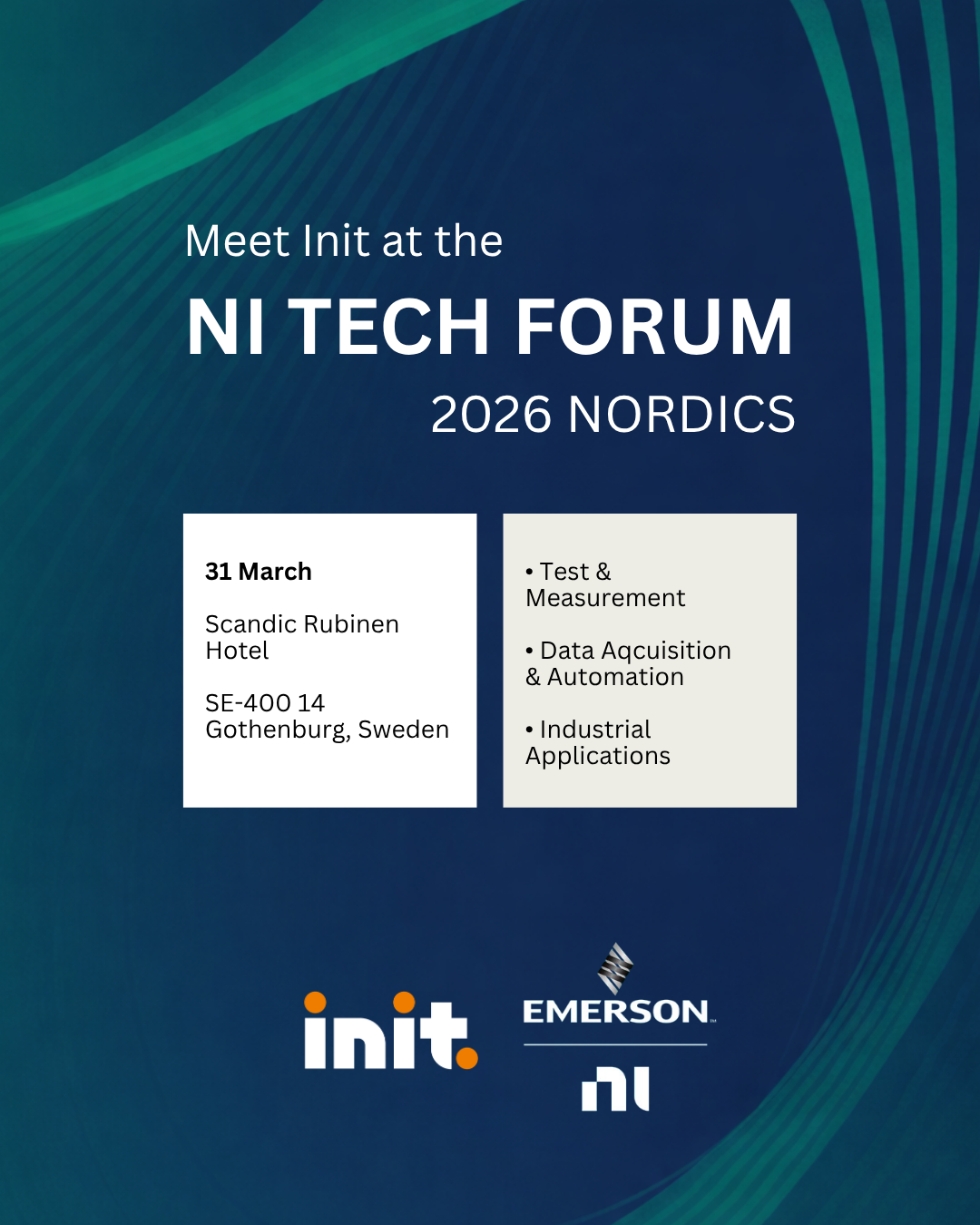
Ahead of the NI Tech Forum Nordics, we share four patterns we commonly see across lab and test environments.
If you work with test, measurement, lab automation, or NI-based systems, you already know the real challenge isn’t getting data – it’s building systems that are reliable, repeatable, scalable, and easy to evolve over time.
At Init, we work with engineering teams to make those systems easier to build, operate, and evolve – by bringing structure to architectures, reducing manual steps, and ensuring data is trustworthy and accessible when it matters.
Below are four patterns we see across R&D and industrial test environments – lab automation, test cells, IT/OT integration, and lifecycle management. We’ll be at NI Tech Forum 31st of March (link at end), and we’d love to compare notes and talk through what these ideas could look like in your setup.
1) Lab automation: turning disconnected instruments into one coherent system
Many labs evolve organically: instruments are added over time, data ends up in separate files or databases, and key workflows remain manual. The result is often slow turnaround, poor repeatability, and limited visibility during test execution. A more modern approach is to treat the lab as a connected ecosystem:
- Integrate instruments, controllers, and subsystems into a unified setup
- Centralise control, logging, and visualisation
- Design for modularity so the system can expand without becoming fragile
- Enable cloud–edge architectures when remote access and shared data matter
The payoff is typically faster configuration, better traceability, and easier access to results for the people who need them.
2) Test cells: reduce setup time while improving accuracy and repeatability
In many validation environments, it’s still common to see separate systems for control and measurement – often combined with manual instrument handling and long setup time whenever requirements change. Integrated test-cell platforms can help by:
- Unifying control and data acquisition in a single system
- Supporting high-speed, precise measurement with synchronized signals
- Automating sequences (including calibration data handling)
- Providing intuitive HMI/SCADA interfaces for operators and engineers
- Making test data easier to access for post-processing and reporting
This is especially valuable when tests change frequently, new instrumentation is introduced, or repeatability is critical.
3) IT/OT integration: access your systems and data from anywhere (securely)
Whether you’re running field monitoring or remote test rigs, a common challenge is getting reliable, continuous data – and making it available to multiple users without compromising uptime or security. Connected monitoring solutions typically focus on:
- Edge platforms for real-time control and data acquisition
- Secure transfer to cloud and/or local storage
- User access management and dashboards for live + historical data
- Scalable architectures that can grow across multiple sites or setups
Done right, this creates dependable insight and reduces the friction of “where is the latest data?” across teams.
4) Lifecycle management: keeping labs maintainable as people and priorities change
Labs often follow episodic investment cycles: a project funds the initial setup or a major refresh, driven by a few key people with deep knowledge and the motivation to improve the lab.
Over the years, however, the lab transitions from development into long-term operations. People change roles or companies, and the team may retain enough knowledge to run the system – but not to continuously evolve it as new requirements, technology trends, best practices, and lifecycle needs emerge.
Modernising a lab can mean architecture cleanup, DevOps practices (e.g., Git + Azure DevOps), and lifecycle upgrades – all aimed at improving maintainability, reducing risk, and making the platform ready for the next phase of development.
Who should attend NI Tech Forum?
The NI Tech Forum is especially relevant if you’re:
- Responsible for lab automation, test infrastructure, or R&D platforms
- Working with NI technologies such as LabVIEW, PXI, CompactRIO / CompactDAQ (or integrating NI into larger systems)
- Dealing with scaling challenges: more tests, more data, more users, more change
- Planning modernisation, upgrades, or a new test/lab architecture
Init is an NI partner, and we’ll be at NI Tech Forum Nordics 2026 to talk about practical ways to make labs and test environments more reliable, scalable, and maintainable – whether you’re building something new or modernising what you already have.
What we’re happy to discuss with you:
- Lab automation patterns for faster turnaround and better traceability
- Test cell architecture and sequencing to reduce setup time and improve repeatability
- IT/OT integration for secure access to live and historical data (edge-to-cloud)
- Lifecycle management and modernization (architecture cleanup, DevOps, upgrades)
Tip: Bring a short description of your current setup (instruments, control/DAQ stack, data flow, pain points).
We’d love to hear what you’re working on and explore options together at NI Tech Forum. Register your complementary ticket for the event HERE.
Related
News | 10 February
Init surpasses DKK 1 billion in revenue ahead of schedule
In just four years, the company has grown from a start-up into a prominent player in the Nordic market for industrial IT and automation.
Read more
News | 01 December
Energy Valley Interviews Init Norway CEO Alexander Risøy
Init Norway CEO Alexander Risøy discusses subsea electrification, collaboration, and the energy future in a new Energy Valley interview. Read the full story.
Read more
News | 03 September
Smarter Automation and Digitalisation for Aquaculture
Highlights from Aqua Nor 2025: conversations on stable operations, proactive control, smarter feeding, and data-driven decisions.
Read more
News | 06 May
(W)Init Skopje: Innovation, Collaboration & Growth
A look back at (W)Init Skopje – a dynamic two-day event for innovation, collaboration, and growth
Read more
Copyright © 2026. All rights reserved. Legal information Privacy Policy Whistleblower Policy Sustainability policy